Osteopath for sports injuries: can it help you further?
For preventing and treating sport-related complaints, an osteopath offers a solution, often in collaboration with your coach or physiotherapist. Think of shoulder problems, groin and hamstring injuries and back and neck complaints. The osteopath looks at the whole movement pattern to address the cause, not just the symptom.
Which complaints does an osteopath treat in athletes?
Osteopathy focuses on complaints with a mechanical cause: joints, muscles, tendons and connective tissue that do not move freely or become overloaded. In athletes this includes, among others:
- Shoulder problems, in throwing, hitting and swimming sports or after one-sided loading.
- Groin injuries, often in runners, footballers and other field-sport athletes.
- Hamstring injuries, from a mild strain to recurring tension at the back of the thigh.
- Back and neck complaints in athletes, caused by posture, impact or repeated loading.
- Overuse complaints, which build up gradually from training too quickly or too much.
- Recurring injuries, where the same complaint keeps coming back.
- Recovery and prevention, to build back up smoothly after an injury and limit relapse.
How does an osteopathic treatment work for athletes?
An osteopath looks not only at the spot where it hurts, but at the whole movement pattern. A groin injury can, for example, be linked to a stiff hip or pelvis, and a shoulder complaint to the mobility of the back. That is why every treatment starts with a thorough interview and a movement examination.
After that the osteopath works manually and gently: with mobilisations, stretches and targeted techniques, movement restrictions are released so that muscles and joints move freely again. You also receive advice on build-up, posture and exercises, tailored to your sport and your training schedule.
Can you prevent sports injuries with osteopathy?
Osteopathy can contribute to injury prevention. By having mobility, balance and compensations checked before any real complaints arise, overuse and recurring injuries are often spotted earlier. Especially with intensive or one-sided loading, this can help to reduce the risk.
Osteopathy is no replacement for good training or rehabilitation. That is why the osteopath is happy to work together with your coach or physiotherapist, so that treatment, build-up and exercise schedule stay aligned. This approach considers your complaint in the context of your sport, not as a standalone symptom.
When to see the osteopath, and when to see a doctor?
For ordinary, mechanical sports complaints you can go directly to the osteopath. Some injuries, however, point to a cause that requires a medical examination first.
Consult a (general) doctor or the emergency department first in case of:
- an acute, severe injury with significant swelling;
- being unable to bear weight on or move the body part;
- a suspected fracture or tear;
- a joint that feels dislocated.
When in doubt, we always consult your doctor. Osteopathy does not replace a medical diagnosis or treatment.
How does your appointment go?
We discuss your complaint, your sport, your training schedule and any imaging.
We examine how your joints, muscles and pelvis move in order to find the cause.
Gentle, manual techniques to release blockages and relieve tension.
Concrete tips on build-up, posture and exercises to prevent relapse.
What can you do yourself to limit injuries?
- Warm up well. A targeted warm-up prepares muscles and joints for the load.
- Build up the load calmly. Increase volume and intensity gradually, not in large jumps.
- Allow enough recovery and sleep. Recovery is just as important as the training itself.
- Do strength training for support. Strong muscles protect joints and tendons.
- Listen to pain signals. Persistent or sharp pain is a reason to ease off and seek advice.
Frequently asked questions about sport and osteopathy
When is the best time to come in after a sports injury?
Does the osteopath work together with my physiotherapist?
Can I come in preventively to avoid injuries?
How many sessions do I need?
Is osteopathy for athletes reimbursed in Belgium?
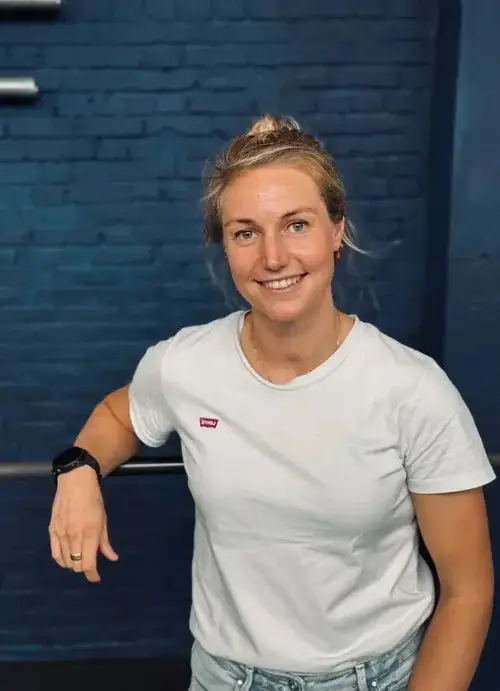
Eline, osteopath D.O.
Eline treats patients with sports and overuse complaints daily at her practice in Berchem and Wilrijk. She combines a thorough examination with a gentle, manual approach and works together with coaches, physiotherapists and general practitioners where needed.
Medical disclaimer. The information on this page is general and does not constitute personal medical advice. Every treatment starts with a personal intake interview and examination. This page is purely informative and does not take your personal situation into account. It does not replace a diagnosis, advice or treatment by a doctor. In case of warning signs, always consult a (general) doctor or the emergency department.
Injury or overuse? Book your appointment
Online, 24/7. Choose your location: Berchem or Wilrijk.